

Graham Potter nonetheless showed up for work on Saturday morning, even though there was nothing left for him to do. A team meeting was scheduled, at which Potter announced to widespread confusion that he had been sacked. Potter departed. Training was delayed because not a soul was available to take it. After a while the new coach, Nuno Espírito Santo, arrived on site and quickly began preparations for the Everton game on Monday.
Perhaps on reflection it was certain that West Ham United’s major managerial decision ended similarly numerous of their set pieces have gone this season. “We’re not West Ham any more,” dissatisfied fans have been chanting at recent protests against the club’s ownership, but examine the evidence. A bungled sacking. A party of contradictory leaks and briefings. Chaotic performances on the pitch. A vacuum of leadership and direction. Catastrophic recruitment. An early relegation battle. Fans in outright protest. I don’t know. Sounds rather West Ham to me.
Jarrod Bowen fights back at Everton to secure a point for West Ham in Nuno’s first game.
In various respects Nuno is the suitable manager for the current shambles, which is not fully a compliment. Nuno will sort out the porous defence, inject some energy in midfield, get the team running as a unit, put some points on the board, turn a diplomatic cheek to the foibles around him and extravagances above him. He will not become a face‑swap meme. He will not go on Monday Night Football to point at a large television and describe what a genius he is.
But what he will fail to do is offer any wider sense of mission and purpose, offer any more extensive footballing vision beyond the creation of player advantages, give this restless and desperately sick club any more distinct idea of its place in the world. The protests may subside. There could be some good, exciting football and a attempt at Europe some day. But West Ham have had these things in the past and it has not provided stability, because what they are missing is in the end something far deeper and more existential.
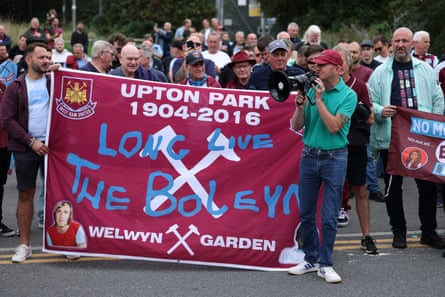
What creates the character of a football club? Location, people, past, memories, emblems, anthems. On foundational assets alone, West Ham should be one of the simplest pitches in English football: an east London institution attracting 62,000 a week, the eighth-oldest club in the Premier League. In a league controlled by unclear funds and investment instruments, it is one of the very few in regional ownership. David Sullivan was raised in Hornchurch and his late co‑owner, David Gold, lived on Green Street. There is a culture and realness, a neighborhood and a global brand, and a great deal of cash to burn. How do you get this so wrong?
It could be the lasting paradox of West Ham is that while it has consistently been a club in London, it has not ever truly been a London club. More correctly it is an East End club, a part of town with its own nature and perspective, its own traditions and language, the grizzled pride that comes with being outsiders in your own city. Not tourist London, not conventional London, but a kind of enclosed citadel where everyone stuck together, where everyone knew who they were because – importantly – everyone knew where they were.
The London Stadium was conceived as a top-tier athletics venue and maybe the kindest thing you can say about it today is that it stays a premier athletics venue. The shallow rake effectively spreads the noise up the back straight; the high distant seats provide a spectacular view of the javelin competition. There is a nice canal alongside and as much boutique street food as you can eat. But a protected haven it is not, and can never be. And truthfully it is the most obvious symptom, if not the root cause, of modern West Ham.
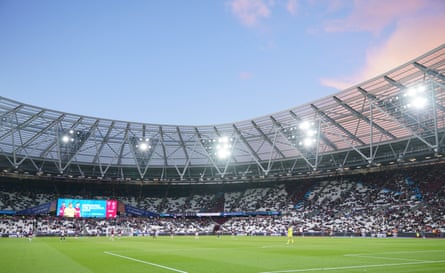
The stadium has ensured the destiny of West Ham, but at the sacrifice of its current state. And imagine being in Sullivan’s and Gold’s shoes for a moment. You assumed control of a club managing nine-figure debts, operating in a fast-escalating league inhabited by billionaires and nation-states. You are not sports specialists but finance professionals, and in this context all your principles are secondary to the first one: you must not, under any circumstances, get relegated next May.
Everything flows from this desire to avoid the drop. This is why West Ham have a squad full of short-term fixes, gathered with no coherent strategy or unified concept. £40m for Max Kilman, £27m for Nicklas Füllkrug … £7m to take Kalvin Phillips on loan. This is why, of the 86 players signed for a fee since the takeover, only three – Dimitri Payet, Flynn Downes and Mohammed Kudus – have generated substantial returns. This is additionally, by the way, how you wind up appointing a head of recruitment in January and almost certainly sacking him before the year is out.
This is why, even though being situated in one of the most abundant talent seams in the sport, not a single academy player born since 2000 has become a established Premier League starter. The potential is out there. Ezri Konsa played at Senrab up the road. Rio Ngumoha honed his game in the five-a-side cages of Newham. Ayden Heaven was in the West Ham academy until the age of 13. The under-18s won the Youth Cup a couple of years ago, and most of them are remaining with the club. But for reasons of opportunity or circumstance, faster-acting clubs or more affluent competitors, this is no longer a place where you can envisage homegrown players succeeding.
The money is obviously there, too. Premier League revenue, European revenue, the Declan Rice fee, capacity crowds every week, the elimination of many reduced ticket categories: why is there so little evidence of West Ham’s prosperity where it matters? Perhaps this accounts for the sense of animosity between the fans and the boardroom: the massive degree of waste, the complete gap between a fanbase feeling increasingly poor and an ownership squandering resources, between a fanbase dedicated permanently and a board that can scarcely plan beyond the weekend. Meanwhile your owner has become increasingly elusive and your vice-chair has a weekly column in the Sun arguing why you all just need to calm down, actually.
And on some level the narrative of West Ham is a parable for something larger than West Ham, something more important even than football. The sense of absence and separation, neighborhoods divided and parcelled off, the utter absence of control and agency, the suspicion that your hard work and your passion are making another party rich. And rare places have endured this process as rapidly or intensely as east London: a community basically removed from itself, cleared and gentrified, inundated with investment that somehow always seems to be flowing somewhere else.
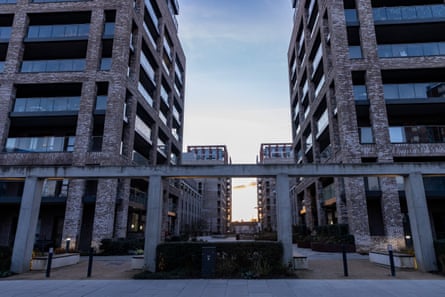
You can even now visit Upton Park now, but it appears a little different these days. The old ground was broken up and disposed of for housing. Ken’s Café on Green Street is now something called Bad Boyz Diner. The old supporters’ club headquarters is now a gym. You can acquire a flat in Lyall House or Sealey Tower, amble along Ironworks Way, sit in the Boleyn Ground memorial garden that has been designed in a bubble-themed design. {Place|Location|Setting
